Monday, February 18, 2008

Do People Control You?
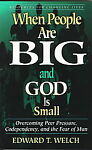
I started rereading Ed Welch's When People Are Big and God is Small today, a book for understanding and then fighting what our culture calls "peer pressure" if we're teenagers or "codependency" and "people pleasing" if we're adults, but what the Bible calls the fear of man, which is a sin.

At the heart of this sin is that we're being controlled by--we are enslaved to--other people, and not God. Here's how the author puts it:
People who fear men "are fairly sure that God loves them, but they also want or need love from other people--or at least they need something from other people. As a result, they are in bondage, controlled by others and feeling empty. They are controlled by whoever or whatever they believe can give them what they think they need. It is true: what or who you need will control you." (13-14).
I'll try to talk through this book more, but for now meditate on that description. Does it describe you? I know it does me.

As an aside: If you're interested in the book, it no longer looks like the picture above because it's been updated. I use that picture because that's the edition of the book I'm reading.

Labels:

Monday, February 11, 2008

Thoughts from the Valley

I wanted to share this part of a prayer called "Pride" in the amazing little book, The Valley of Vision:
"Help me to see myself in thy sight, then pride must wither, decay, die, perish. ... As water rests not on barren hill summits, but flows down to fertilize lowest vales, so make me the lowest of the lowly, that my spiritual riches may exceedingly abound. ... If I fail let me hide myself in my Redeemer's righteousness..."
The last line is essential for living the Christian life and a real joy releaser! The word "if" conveys confidence in God's answering his prayer by supplying him the power he needs to fight pride, while his acknowledging Christ's righteousness shows that his confidence in the face of pride is not in his performance, but in Jesus' performance--a perfect life and a perfect sacrifice, both of which are his by faith!

I know my only hope in the face of my own pride is that Jesus died for it and I'm forever standing before God in His righteousness, not my own.

Labels: , ,

Thursday, January 31, 2008

Sin, War & Exuberance

Becoming a Christian, awakens a person to a war they didn't know was going on before they became a Christian, and one that they find themselves right in the middle of.

To help in this end, I give you this quote by Ed Welch, from pg. 102 of John Piper's When I Don't Desire God to encourage you and give you the attitude you'll need to survive and thrive in this war:
"...there is a mean streak to authentic self-control. ... Self-control is not for the timid. When we want to grow in it, not only do we nurture an exuberance for Jesus Christ, we also demand of ourselves a hatred for sin. ... The only possible attitude towards out-of-control desire is a declaration of all-out war. ... There is something about war that sharpens the senses ... You hear a twig snap or the rustling of leaves and you are in attack mode. Someone coughs and you are ready to pull the trigger. Even after days of little sleep or no sleep, war keeps us vigilant."
I hope that gives you insight into the double-sided attitude needed to fight sin: an overwhelming hatred for sin, and an equally overwhelming exuberance for Christ, which only comes to us through the Spirit's work on our hearts as He glorifies Jesus in the pages of His Word.

Labels: , , , ,

Monday, October 01, 2007

2007 DG National Conference

In Minneapolis this weekend Desiring God hosted its 2007 National Conference. The theme was Stand: A Call for the Endurance of the Saints, and the speakers included John Piper, John MacArthur, Jerry Bridges, Randy Alcorn and Helen Roseveare.

If you're interested, the conference audio us available for free here.

Labels: ,

Sunday, September 16, 2007

Thoughts from the Valley

I wanted to share this part of a prayer called "Spiritual Growth" in The Valley of Vision:
"Give me a tender, wakeful conscience
that can smite and torment me when I sin.
May I be consistent in conversation and conduct,
the same alone as in company,
in prosperity and adversity,
accepting all thy commandments as right,
and hating every false way.
May I never be satisfied with my present spiritual progress..."

Labels: , ,

Friday, September 07, 2007

Ch 2: Desire vs. Delight

I read this sentence, and it is SO true for me. I see this in me and I think about it all the time, and it makes me just sick of myself. Dr. Piper writes:
"We kick ourselves that our cravings for lesser things compete with God as the satisfaction of our souls. ... We know that we have tasted pleasures at his right hand, and that our desires for them are pitifully small compared to their true worth" (28).
I LONG for the day when this will no longer be true of me, when what I know is truly valuable in my mind (God) will match what is actually valuable (God) in my whole being--my emotions and will seamlessly acting in perfect harmony with my mind.

Until then (which will probably only happen at death), I'm still praying for this grace while being SO thankful that God even awoke a taste in me for Him.

Labels: , ,

Thoughts from The Valley

I read this in a collection of Puritan prayers called The Valley of Vision today and had to share it here:
"Give me intenser faith in the eternal verities, burning into me by experience the things I know ... Grant me to know that I truly live only when I live to thee, that all else is trifling" (235)
I need these reminders constantly, daily.

I thank God for this book, and the riches compiled therein.

Labels: ,

Thursday, September 06, 2007

Thoughts from The Valley

I read this in The Valley of Vision today and had to share it here:
"My trials have been fewer than my sins."
For those, like me, who often think bad things happen to me because of bad things I do, I need to hear this.

My life, trials or not, is so saturated by grace all I should do, all day, is thank God.

If you don't have this book, buy it. If you don't have the money, sell something and buy it. You will never regret it.

Labels:

Sovereignty & Suffering

Thank you to Between Two Worlds for posting this convicting and inspiring video. Take 7 minutes and watch it.

I get angry when there's traffic, or my order isn't right at a restaurant, or there's too much noise in the office. I fail to see all of these things as the gracious hand of sovereign providence in my life for my good and to advance God's glory.

I am so convinced by this man's testimony, and so grateful for the Savior who saved me from this constant sin in me.

Labels: , ,

Thursday, August 23, 2007

GREAT NEWS!!!

I found out today that iTunes has finally listed to all the recommendations I made (and others I'm sure), and they put the entire West Coast Revival CD in their music store.

I've been listening to it all day!!!

Also, thank you to my friend Al Moore for making me aware that Sovereign Grace Ministries is now offering all of their mp3 sermons for free.

Here are just a few of the dozens speakers with free sermons to download:

Mark Dever
Wayne Grudem
Carolyn Mahaney
C.J. Mahaney
John MacArthur
Al Mohler
John Piper
David Powlison
R.C. Sproul
Bruce Ware

I hope you're life is enriched by these many of the other excellent resources on this site. Also, if you have any suggestions about speakers or sermons on the SGM site please leave them in the comments. Thank you.

Labels:

Sunday, June 24, 2007

The 49 New Testament One Anothers

Using biblegateway.com I just finished a quick study of the one another commands in the NASB New Testament and this is what I discovered:

If you leave out the four commands to greet one another with a holy kiss (Rom 16:16; 1 Cor 16:20; 2 Cor 13:12; 1 Pet 5:14) there are 49 one another commands in the NT.

The largest category of one anothers are the commands to love (John 13:34-35, 15:12, 17; Rom 12:10, 13:8; 1 Thess 3:12, 4:9; 2 Thess 1:3; 1 Pet 1:22, 4:8; 1 John 3:11, 4:7, 11-12; 2 John 5).

In second place are the commands to edify one another (Rom 14:19; 15:14; Eph 5:19; Col 3:16; 1 Thess 5:11; Heb 3:13, 10:24-25) and a chose third goes to the commands to unite with one another (Mark 9:50; Rom 12:16, 14:19, 15:5, 7; Phil 2:3; 1 Thess 5:13).

Finally, there are almost 20 of what I called miscellaneous one anothers because they could go in multiple categories. These include the commands to give preference to (Rom 12:10), care for (1 Cor 12:25), serve (Gal 5:13; 1 Pet 4:11), tolerate (Eph 4:2), be kind to (Eph 4:32), submit to (Eph 5:21), not lie to (Col 3:9), bear with (Col 3:13), comfort (1 Thess 4:18), not judge (Rom 14:13; 1 Thess 5:13), do good to (1 Thess 5:15), not slander (James 4:11), not complain about (James 5:9), confess sins to (James 5:16), be hospitable toward (1 Pet 4:10), be humble towards (1 Pet 5:5) one another.

I hope that serves you and is helpful. Do you obey and receive the benefits of these commands at your church? What would our churches be like if we actually sought to live them all out?

Labels: ,

Friday, June 08, 2007

Ch 2: Desire vs. Delight? (Pt 2)

I begin this post with a quote from the top of the chapter's second page:
"Godly people are seen yearning, longing, hungering, thirsting, and fainting for God. They are also seen enjoying, delighting in, and being satisfied in God" (24).
This is totally different than the understanding of godliness as almost totally confined to what a person does. This sentence, which I think is biblical, shows that godliness must extend to our emotions as well. In fact, a person who does not enjoy God is being disobedient and therefore, not godly.

Next, I read these portions of the psalms and seriously wonder if that describes me:
"As a deer pants for flowing streams, so pants my soul for you, O God. My soul thirsts for God, for the living God" (42:1-2a).

"O God, you are my God; earnestly I seek you; my soul thirsts for you; my flesh faints for you, as in a dry and weary land where there is no water. So I have looked upon you in the sanctuary, beholding your power and glory. Because your steadfast love is better than life, my lips will praise you" (63:1-3).
Ask yourself, like I've been asking myself, Do I yearn for, thirst for God? Is my compulsion towards God similar to a dehydrated person compulsion for water? Do I seek for God like men with empty canteens search for water in a desert? Can I honestly say I'd rather have God's love for me than life itself?

My answers to these questions, which reflect the drought my heart is experiencing towards God, and how fake I feel when trying to obey verses like Psalm 37:4 or Philippians 4:4 have become some of the reasons why I'm reading this book.

Labels: ,

Saturday, June 02, 2007

Chapter 2: Desire vs. Delight?

These words are exactly my frustration in my growth as a Christian:
"We kick ourselves that our cravings for lesser things compete with God as the satisfaction of our souls."
Thankfully, he doesn't stop there saying,
"Rightly so. This is a godly grief. We do well to be convicted and penitent. We know that we have tasted pleasures at his right hand, and that our desires for them are pitifully small compared to their true worth."
That me right now.

Labels: ,

Thursday, May 17, 2007

Sense and Nonsense in Prayer by Lehman Strauss (Pt 1)

While in seminary I took a class on prayer. We were given a list of books to do a book report that was meant to summarize five ways the book was helpful in building your life of prayer.

What follows is what I learned about prayer from Lehman Strauss' Sense and Nonsense in Prayer, a book I rather enjoyed reading. Please keep in mind as you read that much of this review is biographical and refers to my life from February 2003.

1. God is silent when sin breaks the communion between Him and the believer (pp. 20-24, 49, 64-65, 101).
Believers are not only united with Christ, but John 15:1-8 teaches that they also have a special communion with Him (pp. 63-68). But, while the believer’s union with Christ will never change, their sweet communion with Him can be broken. Believers can erect “a barrier” (pp. 21, 101) or put an “obstacle” (p. 49) or “cut the lifeline” (p. 21) between them and God by sinning.

Experientially, I knew this. There have been times where the weight of my sin was so heavy that it felt like God was far away from me. However, I did not know of any biblical support for my feelings, which left me confused until Strauss’ biblical references on the separating effects of sin hit me squarely on the chin (see Ps 66:18; Isa 1:13-15; 59:1-2).

Understanding that “[I] am responsible for God’s silence” (p. 21) is driving me to seek a deeper level of righteousness. Taking this principle seriously, I am currently tracking someone down who I sinned against many years ago to ask her for forgiveness so my prayers will “accomplish much” (Jas 5:16).
2. There is a direct correlation between the believer’s concept of God and his prayers (pp. 35, 39).
In the context of praying in Jesus’ name (pp. 35-41), Strauss asserts that “prayer rises or falls with one’s concept of Jesus Christ” (p. 35), a principle that would have been even stronger had he incorporated verses like Hosea 4:6; 6:6 and Jeremiah 4:23 into his discourse.

While I generally agree with this statement, I would clarify it by saying prayer rises or falls with the believer’s concept of God because, as Strauss teaches later in the book (pp. 120-21) we do not pray only to Jesus, but to all the persons of the Trinity. He goes on to say that anyone “who holds a light view of the Lord Jesus Christ cannot have a worthwhile prayer life” (35).

The believer who does not know what Jesus is like cannot pray to Him as they ought. He is not able to trust Him freely, or love Him deeply, or ascribe to Him the glory He deserves. After a while, these prayers disrespect the King, making it so that the ignorant believer has “no right to expect God to answer his prayers” (39).

Because of this principle I am now incorporating the Bible into my prayers by meditating on a verse of 2 Timothy every day before praying. The verse I turn over in my mind than becomes my springboard into praise/thanks, confession, etc. This way, I am learning about God as I pray and therefore, I am able to pray according to that knowledge.
3. It is “rude imposition” (p. 58) to ask God for anything without an attitude of thanksgiving (pp. 57-62).
Asking God for anything must be saturated by praise/thanksgiving for everything. I grew up ignorantly treating God like a cosmic bellhop who was supposed to jump at my requests. It was only in the past few years that I realized I deserve nothing good from God and therefore, “whenever [I] approach God for anything, [I] should not fail to thank Him for those blessings and mercies [I] have already received” (pp. 58).

According to Psalm 100:4, the right way to approach God’s throne is with praise/thanksgiving and blessings. This biblical teaching in Strauss’ book and the discipline of daily prayer has taught me that my prayers are very self-centered.

For instance, when I was in 2 Timothy 2:25 a few weeks ago I desperately cried out to God for my grandpa’s salvation after my grandma died. However, my prayers of praise/thanksgiving for his receiving Christ still lack the same fervency and urgency of my entreaties for his salvation (prayers God graciously answered in December 2006).

Therefore, Strauss’ insights have been driving me to begin my prayer time with praise/thanks to God for an attribute of His character related to the verse I am studying in 2 Timothy (e.g., mercy in 2:25) as passionately and intentionally as I petition Him.
I'll finish this book review in the next post.

Labels: ,

Tuesday, May 01, 2007

Chapter 1: Why I Wrote This Book (Pt 3)

I had to give this quote from C.S. Lewis. Read it carefully and apply it to your desires for and satisfactions in God:
"Provided the thing is in itself right, the more one likes it and the less one has to 'try to be good,' the better. A perfect man would never act from sense of duty; he'd always want the right thing more than the wrong one. Duty is only a substitute for love (of God and of other people), like a crutch, which is a substitute for a leg. Most of us need the crutch at times; but of course it's idiotic to use the crutch when our own legs (our own loves, tastes, habits, etc.) can do the journey on their own!" (C.S. Lewis: Letters to Children, 276).
I am reading this book because I want "a joy in Christ that is so deep and so strong that it will free me from bondage to Western comforts and security, and will impel me into sacrifices of mercy and missions, and will sustain me in the face of martyrdom. ... The key to endurance in the cause of self-sacrificing love is not heroic willpower, but deep, unshakable confidence that the joy we have tasted in fellowship with Christ will not disappoint us in death" like the Christians in Hebrews 10:34 (20, 21).

My heart screams "Yes!" when I read this, yet my experience feels like it mirrors the blind man who tries to ride a dead horse that he doesn't know is dead. He commands it, and kicks it, and yells, yet it goes no where. That is often how my heart feels inside me, and I want that so desperately to change.

I want to "truly experience...the unsurpassed worth of Jesus with so much joy that [I] can say, 'I count everything as loss because of the surpassing worth of knowing Christ Jesus my Lord' (Phil 3:8)" (21).

This is the only kind of experience that is worthy of the Savior!

Labels: , , ,

Thursday, April 26, 2007

Chapter 1: Why I Wrote This Book (Pt 2)

Dr. Piper wrote this book to answer the questions "How do you get a desire [for God that] you don't have and can't create?" or "How to you turn the spark into a flame?" (15). And, I'm not going to lie, that's why I wanted to read this book.

I am not interested in superficial, wishy-washy, half-in half-out, luke warm devotion to God. I'm just not and when I think and feel and live that way I hate myself. I really want God to use this book as a catalyst to begin something deep and lasting and real in my soul.

I want so badly to be the person Jonathan Edwards describes who sets no limit on his religious appetites and endeavors "by all possible ways to inflame their desires and to obtain more spiritual pleasures" because one's hungering for the Trinity and holiness "can't be too great for the value of these things, for they are things of infinite value" (17). When it comes to desiring God, balance, or as Edwards puts it "temperance," is not a virtue.

Labels: , , , ,

Thursday, April 19, 2007

Chapter 1: Why I Wrote This Book (Pt 1)

Honestly, we're reading this book because we don't desire God like we should, and we don't feel good about it.

We're convinced God is the object most to be desired because He is infinitely desirable, but in my most honest moments, I don't think about Him that way, I don't feel about Him that way and I don't act that way towards Him. I join my name to the list of those who do not desire "God with the passion he demands" (13).

This gets worse because God the Most Desirable does not leave the finding of joy in Him as an option I can take or leave. "Rejoice in the Lord always" is a command!

But between me and my full satisfaction in God stands my indwelling sin "by making other things look more desirable" and "by making me think I am pursuing joy in God, when, in fact, I am in love with his gifts" (14).

As a result, I agree with Piper that in light of this almost insurmountable struggle a "manageable, duty-driven, decision-oriented, willpower Christianity now seem[s] easy, and real Christianity ha[s] become impossible" (14).

Sadly, if I'm honest with myself I want knowledge and status and comfort and security more than God. And, I not only feel like I don't have a desire for God, but I feel like I don't have the power to give it to myself.

This is a very real reality for me. One I recognize and struggle with, and desperately want changed. That's why I'm looking so forward to reading this book. Piper says he wrote it "to be of help to believers and unbelievers who are seeing some of the radical heart-changes demanded by the Bible in the Christian life--especially that we must desire God more than anything" (15).

Thankfully, this struggle is "almost insurmountable," and it's almost because we serve a God for whom "all things are possible" (Mark 10:27). In this reality is my only hope. Heart transformation is God's sovereign, gracious work, and one that I remember saying "Pray all night if you don't have it."

Labels: , , ,

Thursday, April 12, 2007

Augustine on Pride

In the midst of his wrestling with God in his Confessions, Augustine makes this priceless statement about pride:
"By my swelling pride I was separated from You, and my bloated cheeks blinded my eyes" (VII.11).
Can't you just picture an obese man who's eyes squint under the pressure coming up from his inflated cheeks?

Pride not only separates a person from God, but it blinds him to God, blinds him to the separation and blinds him from the fact that it's precisely his pride that has caused this separation.

Labels: , ,

John Piper's When I Don't Desire God

The next book we're going to read through as well as blog through is John Piper's When I Don't Desire God.

My friend's wife agrees with John Piper himself that if you're going to read one book this is the one to read (Piper said this in this interview).

We decided to do it because a lot of our conversations while reading through Lundgaard's The Enemy Within revolved around why our Christian lives are so difficult and dull and just plain blah compared to when we were first saved. We concluded that God gives a special grace to new believers, and that it's lost overtime for various reasons and needs to be sought after and regained.

I'm sure we're both praying that God will use this book to confront and convict us of our sins as well as reinvigorate our spiritual lives.

Labels: ,

Wednesday, April 04, 2007

Clear Your Schedule & Listen

While passing out flyers today for my dad's business I've been walking from house to house listening to the message below by Dr. Paul Tripp (author of Instruments in the Redeemer's Hands) from Southeastern Baptist Theological Seminary's 2007 Theology Driven Ministry Conference.

I told my friend just now that listening to them has been like having someone cut open my chest to allow the light of God's Word to shine on my heart and I've been getting filleted.
  1. Your Walk with God is a Community Project (Tripp)
  2. Progressive Sanctification and the Anti-Social Nature of Sin (Tripp)
  3. The Pastor's Role in Sanctification (Ferguson)
  4. Colossians 3:1-17 (Ferguson)
  5. Sanctification in the Middle of the Messiness of Relationships (Tripp)
  6. Looking in the Mirror: James 1 (Ferguson)
  7. Playing in the Box: Romans 7 (Tripp)
If you click on the message's name you can listen instantly, and if you press Control and click your mouse on the link (or Right click if you have a PC), you should be able to start downloading it (if it doesn't, let me know). If that doesn't work, click here to subscribe to the podcast, or click here and scroll down to March 26th and you'll see the conference audio.

I've listened to the first two of Dr. Tripp's four messages so far, and I've also included the messages from Dr. Sinclair Ferguson to have the full conference. The last two were given in the same venue at the same time, but for a reason I don't know they weren't part of the conference.

I hope you're as challenged and rebuked and encouraged and grateful for the Savior as a result of these as I have been.

Labels: , ,